









By: Danny Karmin
About 15 minutes past the final horn, as the Zamboni begins its final wash and fans depart Allstate Arena, the Wolves begin their final shift of the night: The postgame off-ice workout.
Led by Wolves Strength and Conditioning coach Jack Rinzel, the team undergoes intense and efficient workouts once or twice a week that coincide with the team’s game schedule.
Rinzel, who was hired last August, stresses that due to the condensed American Hockey League season and limited recovery time, each player’s fitness is top of mind for the present and future.
“The biggest thing is that these guys play so many games and they really only get one off-day a week and that’s going to be after they play two games in a row, or they play the night before,” Rinzel said. “We want to keep a recovery day focused on recovery.
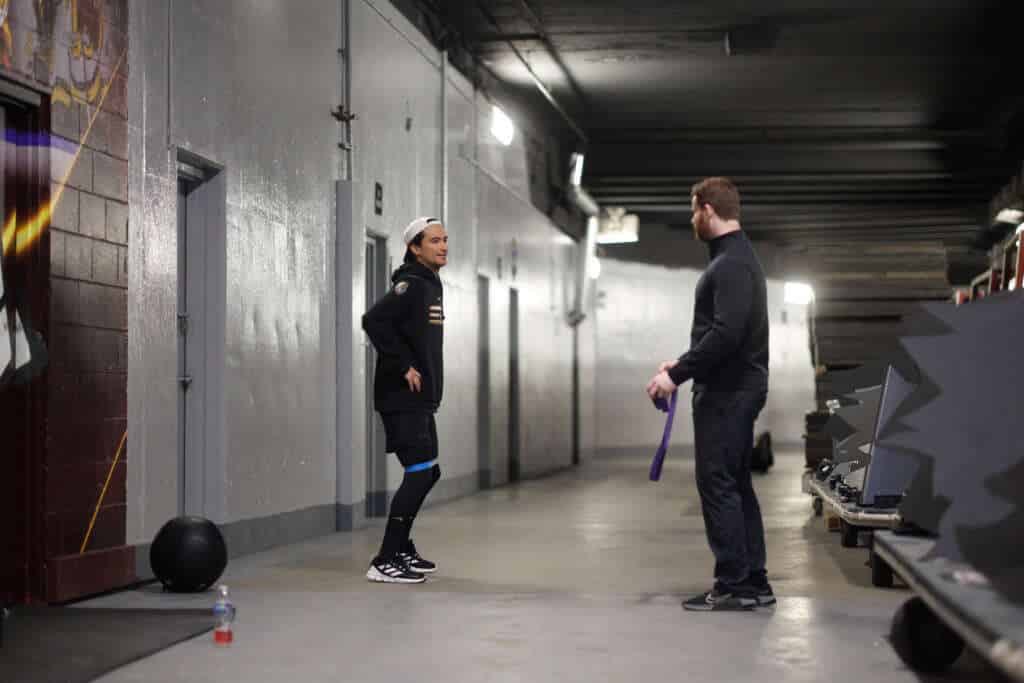
“If we try to schedule a lift on those recovery days, now all seven days of the week are hard,” Rinzel continued. “So we just take the game day, which we already know is hard, and then we just add a short lift after it. So the hard days stay hard and the easy days stay easy.”
The so-called “easy days” include individually tailored exercises such as dumbbell split squats and sprints. The non-game-day workouts usually involve heavier compounds in deadlifts and squats.
Recovery days are crucial, especially for the younger players adapting to professional hockey and increasing their strength year after year.
“They’re going to need to be in the habit of getting their workouts in postgame because that’s going to be the norm in the NHL,” Rinzel said. “We want to make sure that they’re exposed to that here so that when they do make that jump, they’re ready for that. It’s not going to be a surprise to their system.”
It’s not always the easiest to motivate a large group to consistently put in the work during a long season but the Wolves don’t experience that.
“We haven’t had to push guys forward very much and I think it’s a testament to our coaching staff and the players and what they value as well, which as a strength coach you love,” Rinzel said. “There’s not a single guy on the team who cuts corners or tries to do things their own way. Some of the things we might do may be a little unconventional, but these guys take it in stride and they believe it’s going to help them.”
One player who reaped the benefits was second-year breakout forward Felix Unger Sorum. The 20-year-old from Trondheim, Norway, experienced massive gains with his on-ice production and physical strength from just a season ago.
Unger Sorum led the Wolves in scoring with 66 points (17 goals, 49 assists) during the 2025-26 season–a 46-point increase from the prior campaign.
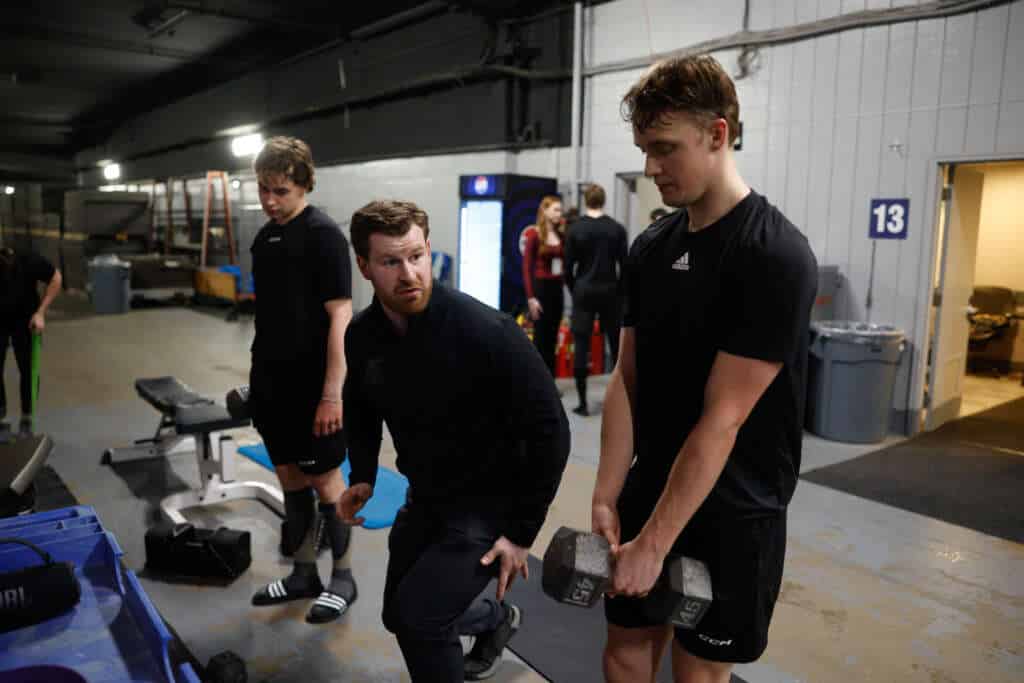
“You look at when we started this year in October, the biggest need that we found was going to help (Unger Sorum) the most was just getting stronger in general,” Rinzel said. “He worked really hard to add strength and he’s a much more powerful and faster skater now. You can see that in this game and his playing style.”
Unger Sorum focused on lower-body strength to aid him in 50/50 battles and puck protection along the boards.
“(Rinzel) helped me a lot this year,” Unger Sorum said. “I had to get stronger and faster and I felt like I accomplished that this season. I definitely was more comfortable on the ice and excited to continue to get better next season.”
